
FM Consulting
Delivery Process Transformation
Brought structure and reliability to a multi-team delivery environment by improving ownership, planning, and stakeholder visibility.
Case study
The problem
A product engineering organization of roughly ninety people, split across seven teams, had outgrown its planning model. Each team tracked its own sprint commitments in Jira with no shared definition of "on track" or "at risk," so a slipping cross-team dependency typically surfaced only once it was already late. Across two consecutive quarters, close to half of the roadmap items publicly committed to stakeholders shipped later than announced — and because there was no shared risk signal, leadership, sales, and support each found out on their own schedule, usually from a different, inconsistent status update. Escalations were reactive: by the time something was flagged internally as at risk, there was rarely enough runway left to recover cleanly.
The solution
Rather than adding process, the engagement replaced several redundant, team-specific status meetings with one shared mechanism: a single cross-team risk board, reviewed weekly, with every active initiative carrying exactly one accountable owner and a three-state flag — on track, at risk, or blocked — that the owner had to set explicitly rather than have it inferred from ticket status. "At risk" required naming what would resolve it, not just a color change, which turned the weekly review into a decision-forcing checkpoint instead of a status readout. Stakeholder reporting was consolidated into that same single source, so sales, support, and leadership were finally looking at the same numbers on the same cadence instead of reconciling three different narratives.
How it was built
The board was built on the org's existing Jira and Confluence setup rather than a new tool — a saved cross-project Jira filter feeding a lightweight Confluence dashboard — specifically so adoption didn't require learning new software, only keeping a few fields current. Reassigning ownership to a single named person per initiative, rather than a team, was the change that did the most work on its own: it immediately surfaced several initiatives nobody was actually driving, which had been quietly slipping for exactly that reason. The weekly review stayed deliberately short — thirty minutes, initiative owners plus one delivery lead — with the standing rule that a flag without a stated next action wasn't a valid update. Within two quarters, on-time delivery against publicly committed dates improved noticeably, and last-minute escalations to leadership dropped, since risks were now visible weeks earlier instead of days.
More projects
- Transformation
- Operations
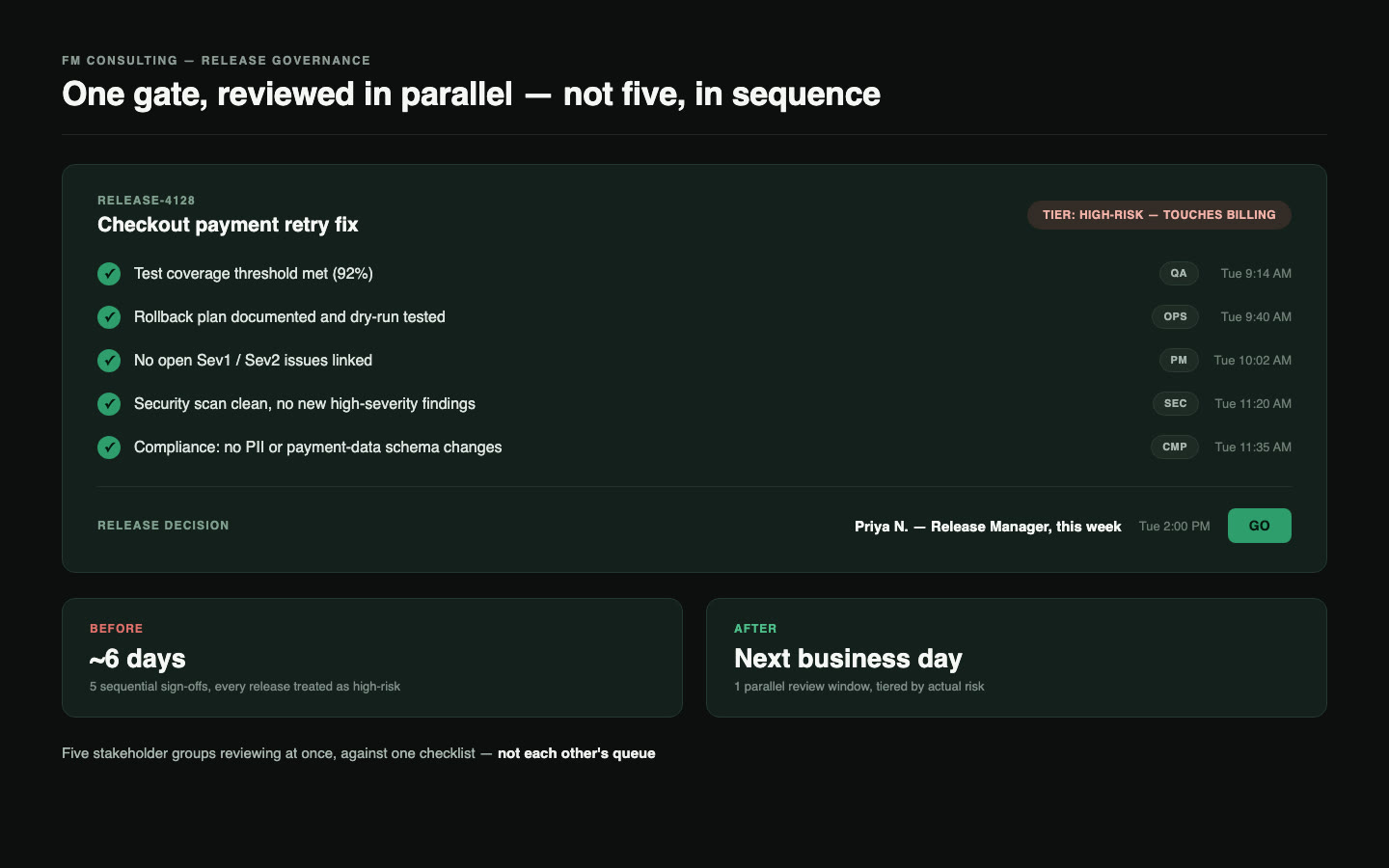
Release Governance Acceleration Initiative
Improved release predictability by standardizing readiness gates, ownership, and cross-team decision flow.
- Transformation
- Operations
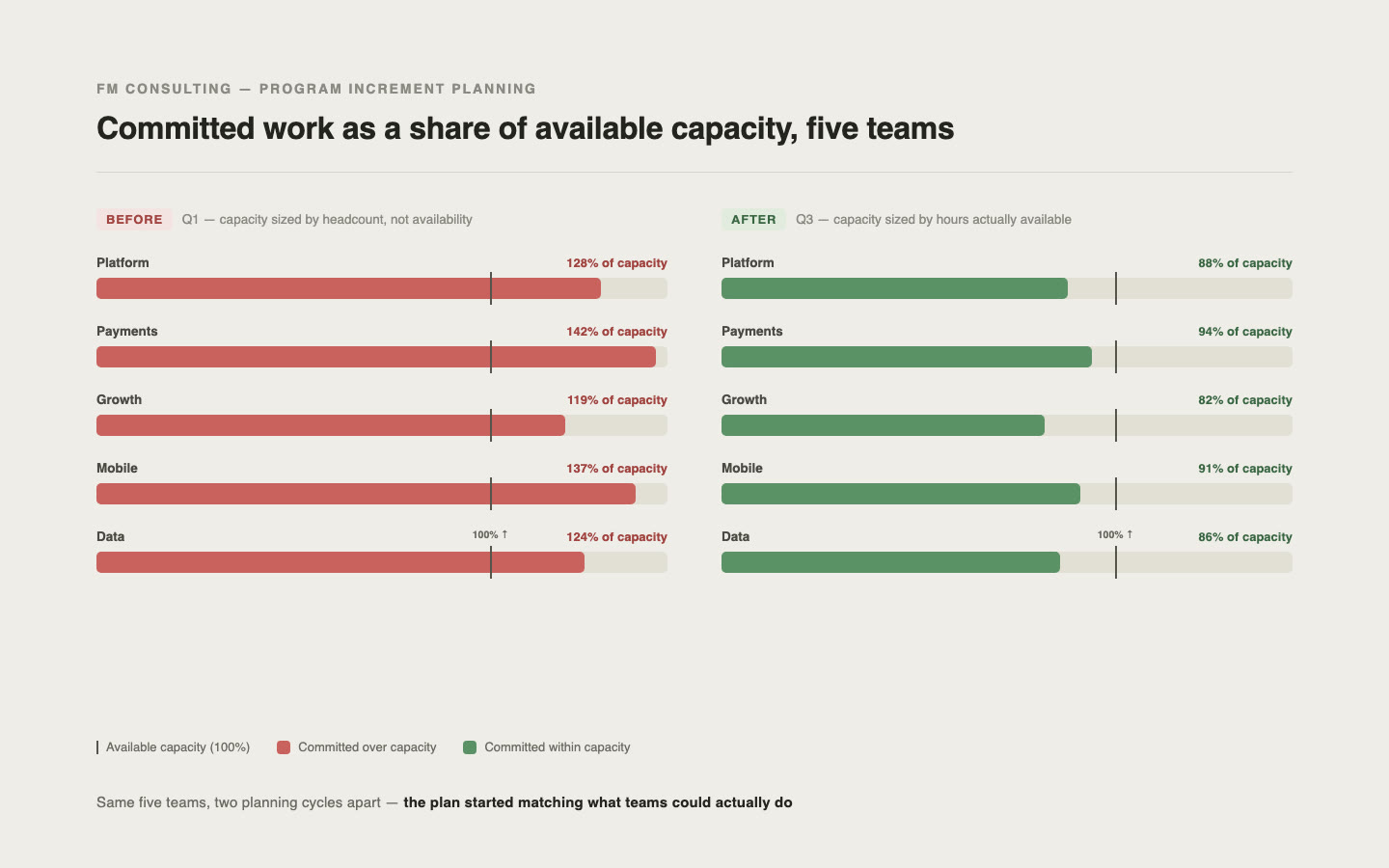
Program Increment Planning Reset
Re-established delivery momentum by restructuring planning cycles around capacity, dependencies, and outcomes.
- Operations
- Customer Experience
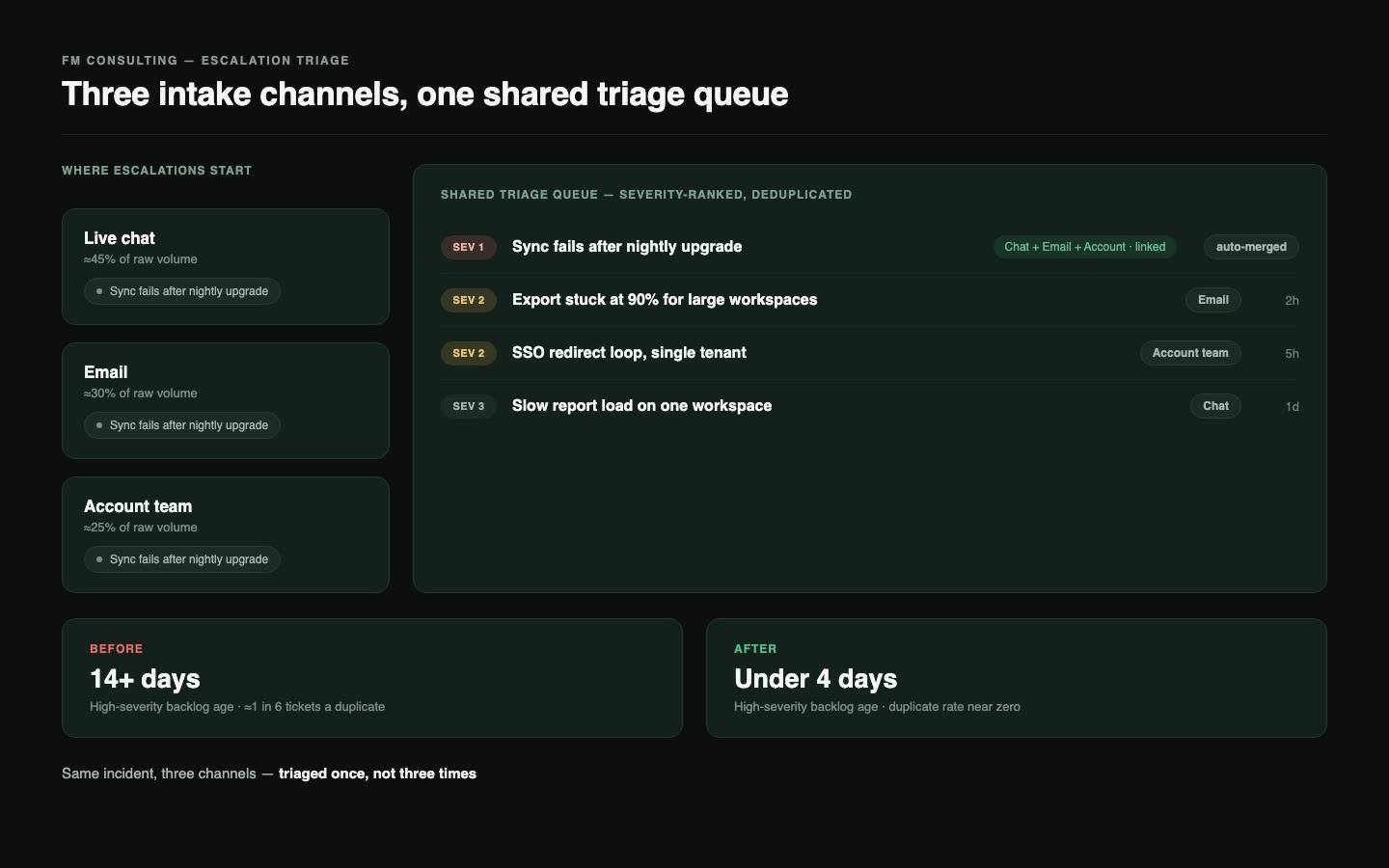
Cross-Channel Escalation Triage Program
Reduced escalation backlog by introducing a shared triage operating model across support, product, and engineering.